

Quantum computing has been in the news more and more these days, and as I study this subject, the more I am convinced that quantum computing will become the next great investment paradigm.
Now, what do I mean by paradigms? These are not investments, per se. They are technological platforms that can spawn dozens of new industries. Each industry can inspire hundreds of companies, and it’s at this company level that investment opportunities exist.
Examples of past investment paradigms include:
- The early-mid 1800s: Steam engines brought us railroads and steamboats, allowing travel over long distances to be practical and affordable.
- Late 1800s: Electricity dramatically changed industries, telecommunications and the lives of the average person.
- Early 1900s: The internal combustion engine gave us cars and airplanes.
- Mid 1900s: Computers changed the business and scientific landscape.
- 1990s: The Internet changed the way we shop, communicate and socialize.
- 2010s: Artificial Intelligence is already changing our lives in big ways.
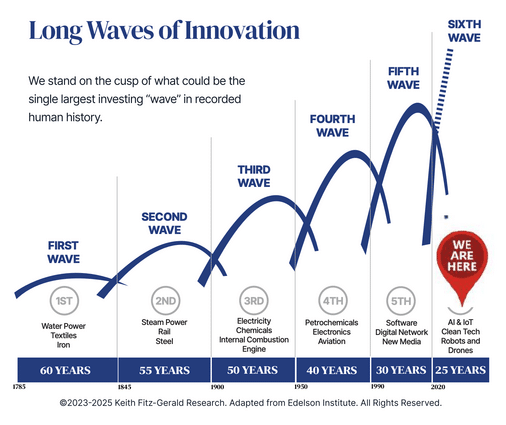
As you can see in this illustration, the time span between the acceptance of each new technology platform is getting shorter and shorter. If you feel like technology is advancing at a dizzying pace, you are not wrong.
Artificial Intelligence has already been around for 10-15 years, but has only recently been adapted for use by you and me. And with the rapid advance of technology, AI as an investment has already made significant money for some investors, so it may be getting to be “old news.” As an investment researcher, I am not interested in what made money in the past, but what will make us money in the future. In my opinion, quantum computing can do just that.
These are powerful machines that use the strange physics of quantum mechanics to solve problems that are far too complex for even today’s fastest supercomputers.
It seemed that quantum computing was always spoken about in future-speak, but it is getting to be very real, right now, as quantum computers are coming online.
Traditional, binary computers (ones that treat all data as 0s and 1s – like switches that are either on or off) are designed to logically solve one problem at a time. It may seem to us that many things are done at once, but each processor still solves one problem at a time, just really, really fast.
Quantum computing is different from traditional computing because, instead of using regular computer bits that are always either 0 or 1, it uses special units called qubits that can be 0, 1, or both at the same time because of the rules of quantum physics.
This allows quantum computers to try many possible answers all at once, quickly solving seemingly chaotic problems that regular computers would take years and years to complete.
The speed of quantum computers can be millions of times faster than traditional computers – let that sink in a minute. Millions of times faster than today’s computers! But it is not just speed that differentiates quantum computing from traditional binary computers, it is the ability to handle the element of chance and chaos.
Over the past 50 years, attempts to predict the weather with supercomputers have produced only so-so results. The problem was that weather was not a single system, but a complex interaction of many systems simultaneously. We need computers that can handle chaotic systems like the weather. And quantum computers seem to be just the ticket.
One problem quantum computing faces is that qubits are very fragile and can lose their quantum state quickly if their environment changes. Until recently, quantum computers have required very cold, specialized environments, making them expensive and hard to maintain.
There are currently two business models unfolding in the quantum computing arena. The first are “pure plays”: companies that actually make quantum computers and the associated hardware. These are companies such as IonQ (IONQ), D-Wave (QBTS) and Rigetti Computing (RGTI).
Rigetti builds “superconducting qubit” computers that operate at the extremely cold temperatures currently required for superconductivity.
Superconductivity enables the transmission of electricity with virtually zero resistance, increasing energy efficiency and reducing power losses in electrical grids and electrical motors. It also facilitates the creation of powerful magnetic fields, essential for advanced technologies like MRI machines, maglev trains, and atom-smashing, particle accelerators.
IonQ is focusing on a newer technology called “trapped ion” qubits, that is reported to provide superconductivity at more normal temperatures and therefore may be less fragile.
The second business model is to lease out time on quantum computers that the company owns, and this space is currently dominated by big names such as Alphabet (GOOG, GOOGL), Amazon (AMZN), IBM (IBM), and Microsoft (MSFT).
Quantum computing is very much still a work in progress, with uses still being developed and lots of technical challenges to solve. Which technology will become more successful over time is hard to guess. So, I guess I should make clear that I’m not a physicist – even though I did sleep in a Holiday Inn Express one time.
We are going to see real game-changing discoveries made using quantum computers, when more and more of the research universities, corporate R&D departments, and laboratories get their own on-site machines. A search on Perplexity.ai tells me that only a dozen or so universities and companies currently have functioning quantum computers, but a few years back, this number was zero. But quantum computers do exist. They are happening right now.
Quantum computing will augment traditional computing systems rather than replace them. Even so, we are clearly at the beginning of the quantum computing age. This is expected to usher in huge discoveries for humankind and huge markets for their providers in areas like medicine and building materials.
How big is the market, you might ask? The quantum computing industry has just started producing revenues. Quantum companies surged from roughly $650 million of revenue in 2024 to a forecasted $1 billion-plus in 2025, an outstanding 53% growth in one year*. But revenues in this market are expected to explode to $70 billion by 2030**, more than doubling each year.
In my investment research, I focus only on investable companies in this space. Many private companies are trying to become players in the quantum computing field, but I try not to get distracted by those, since you and I cannot invest in startups.
In my opinion, the companies that I have mentioned here are the main ones to keep an eye on over the next few years as this industry matures.
Footnotes:
*according to the quantuminsider.com
**per money.usnews reported on Perplexity.ai
Disclosure, Shadowridge clients invested in the Future Technologies portfolio own shares of Ionq (IONQ), Rigetti (RGTI) and Microsoft (MSFT). We do not own shares of Alphabet (GOOG, GOOGL) or IBM (IBM) nor do we have them our buy lists.

Important Disclosure Information
Please remember that past performance is no guarantee of future results. Different types of investments involve varying degrees of risk, and there can be no assurance that the future performance of any specific investment, investment strategy, or product (including the investments and/or investment strategies recommended or undertaken by Shadowridge Asset Management, LLC [“Shadowridge]), or any non-investment related content, made reference to directly or indirectly in this commentary will be profitable, equal any corresponding indicated historical performance level(s), be suitable for your portfolio or individual situation, or prove successful. Due to various factors, including changing market conditions and/or applicable laws, the content may no longer be reflective of current opinions or positions. Moreover, no portion of the foregoing content serves as the receipt of, or a substitute for, personalized investment advice from Shadowridge. Neither Shadowridge’s investment adviser registration status, nor any amount of prior experience or success, should be construed that a certain level of results or satisfaction will be achieved if Shadowridge is engaged, or continues to be engaged, to provide investment advisory services. Shadowridge is neither a law firm, nor a certified public accounting firm, and no portion of the commentary content should be construed as legal or accounting advice. A copy of the Shadowridge’s current written disclosure Brochure and Form CRS discussing our advisory services and fees continues to remain available upon request or at www.shadowridgeinvest.com. Please Remember: If you are a Shadowridge client, please contact Shadowridge, in writing, if there are any changes in your personal/financial situation or investment objectives for the purpose of reviewing/evaluating/revising our previous recommendations and/or services, or if you would like to impose, add, or to modify any reasonable restrictions to our investment advisory services. Unless, and until, you notify us, in writing, to the contrary, we shall continue to provide services as we do currently. Please Also Remember to advise us if you have not been receiving account statements (at least quarterly) from the account custodian.
Historical performance results for investment indices, benchmarks, and/or categories have been provided for general informational/comparison purposes only, and generally do not reflect the deduction of transaction and/or custodial charges, the deduction of an investment management fee, nor the impact of taxes, the incurrence of which would have the effect of decreasing historical performance results. It should not be assumed that your Shadowridge account holdings correspond directly to any comparative indices or categories. Please Also Note: (1) comparative benchmarks/indices may be more or less volatile than your Shadowridge accounts; and, (2) a description of each comparative benchmark/index is available upon request or at www.shadowridgeinvest.com.