

The stock market has been on quite a ride since the end of last month. Many major indexes appeared to have bottomed just before March ended, kicking off a surprisingly strong rally that brought new highs to several of these indexes. I had mentioned last month that one of the biggest risks we saw was for a dramatic reversal off the lows due to a “rapid shift in sentiment.” That is exactly what we got.
The pullback’s bottom in March concluded a 43-day drawdown in the S&P 500 that only moved -8.9% from a late January peak. However, the NASDAQ 100 had a different story. It peaked in late October and had an almost -12% drawdown over a much longer 103 trading days.
As we mentioned last month, the price of Oil has been a key factor in how the stock market has moved recently. Of course, the Iran conflict is a factor, but even without that, the price of oil could slow the world economy if it stays too high for too long. But just as April started, the price of oil peaked and somewhat rapidly reversed course. Now it is at a price level that is much more reasonable for the world to keep moving. This remains a key factor in where the market goes next, so it is something we’re watching closely.
On my monthly webinar/video market commentary, I like to reference various Seasonality cycles. And we are still in the 2nd year of the 4-year presidential cycle, which tends to be a tough year with increased volatility. There can still be bright spots, but this cycle is a time to be quicker to protect investments if the data supports it. So far, however, we really haven’t seen much negativity.
This month’s chart is a look at the S&P 500 (SPY ETF) with the Money Flow Index (MFI). When the MFI reading goes above 80, it tends to be at or near the end of a run up. We find it’s a good time to take a look at profits made and consider trimming back. Or for investors who are living off their investment income, this is one of those times where it can make sense to re-fill the distribution bucket. This helps us refill that income bucket when things are good and the market is high, and this signal doesn’t happen very often. Over the past year, there have only been 3 times where MFI crossed above the 80 level.
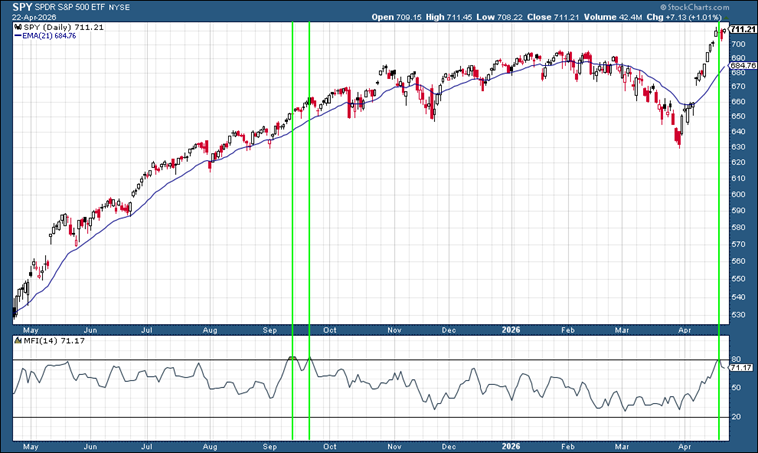
One-Year chart of the S&P 500 (SPY ETF) with MFI Indicator below (Source: StockCharts.com)
Our Shadowridge Long-Term Trend indicator turned positive again on April 8th, suggesting that the market could continue moving higher. This data tends to stay positive for a while when it turns, so the recent volatility may be behind us for now (barring any unexpected news).
Our Mid-Term Cycle indicator turned positive on April 2nd and has had an outsized move upward. However, it now suggests the run-up has slowed down a bit. For now, it remains positive, but as they say, the easy money has been made. Now we watch and wait to see what’s next.
As of Wednesday night (April 22nd, 2026), our Shadowridge Dashboard showed Positive to Negative market sectors as 7 to 4. The sectors on the negative side are largely defensive areas, like Healthcare, Utilities, and Consumer Staples. For now, that’s a sign that the growth-oriented sectors are back to leading the market.
Right now, all 10 RGB Bond Indexes are back to trending positive, all above their 50-day Moving Averages. Bond sectors across the board weren’t much help during the sell-off we saw in March, suggesting that correlations remain high and not giving us much reason to use them for diversifiers.
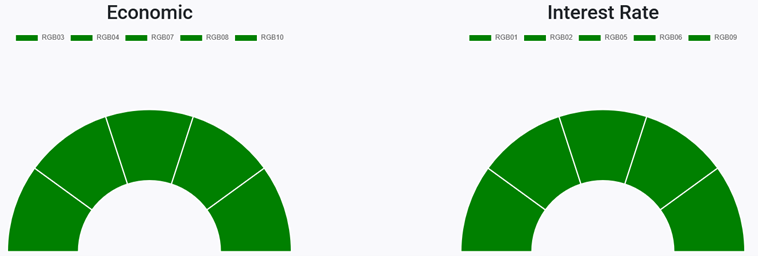
RGB Economic and Interest Rate Sensitive Bond sectors (Source: ShadowridgeData.com)
Traditional Bond sectors have recently offered limited diversification benefits during periods of volatility. The 7–10-year Treasuries (IEF) and the Aggregate Bond Index (AGG) didn’t do much to help offset portfolio risk by owning them in March. However, many short-term and ultra-short-term bond sectors held their ground and even made progress while the market had its pullback. We continue to believe that the entire point of having bonds in a portfolio is to reduce risk, so our picks in this area tend to be outside the box of what we see as traditionally offered.
Bottom Line: We’ve seen a solid rebound and recovery of many market indexes following a long-ish and slow grind downward. But it never looked bad enough to have to take anything more than some basic defensive measures. And we’ve participated in the recent recovery. While the data suggests the Iran and oil issues may have stabilized, there is still the possibility of headline risk or some news event (that tends to happen over the weekend when we can’t do much about it) that moves the market in unexpected ways. For now, we remain optimistic, but at the ready if data suggests getting defensive.
Stay safe out there!
Important Disclosure Information
Please remember that past performance is no guarantee of future results. Different types of investments involve varying degrees of risk, and there can be no assurance that the future performance of any specific investment, investment strategy, or product (including the investments and/or investment strategies recommended or undertaken by Shadowridge Asset Management, LLC [“Shadowridge]), or any non-investment related content, made reference to directly or indirectly in this commentary will be profitable, equal any corresponding indicated historical performance level(s), be suitable for your portfolio or individual situation, or prove successful. Due to various factors, including changing market conditions and/or applicable laws, the content may no longer be reflective of current opinions or positions. Moreover, no portion of the foregoing content serves as the receipt of, or a substitute for, personalized investment advice from Shadowridge. Neither Shadowridge’s investment adviser registration status, nor any amount of prior experience or success, should be construed that a certain level of results or satisfaction will be achieved if Shadowridge is engaged, or continues to be engaged, to provide investment advisory services. Shadowridge is neither a law firm, nor a certified public accounting firm, and no portion of the commentary content should be construed as legal or accounting advice. A copy of the Shadowridge’s current written disclosure Brochure and Form CRS discussing our advisory services and fees continues to remain available upon request or at www.shadowridgeinvest.com. Please Remember: If you are a Shadowridge client, please contact Shadowridge, in writing, if there are any changes in your personal/financial situation or investment objectives for the purpose of reviewing/evaluating/revising our previous recommendations and/or services, or if you would like to impose, add, or to modify any reasonable restrictions to our investment advisory services. Unless, and until, you notify us, in writing, to the contrary, we shall continue to provide services as we do currently. Please Also Remember to advise us if you have not been receiving account statements (at least quarterly) from the account custodian.
Historical performance results for investment indices, benchmarks, and/or categories have been provided for general informational/comparison purposes only, and generally do not reflect the deduction of transaction and/or custodial charges, the deduction of an investment management fee, nor the impact of taxes, the incurrence of which would have the effect of decreasing historical performance results. It should not be assumed that your Shadowridge account holdings correspond directly to any comparative indices or categories. Please Also Note: (1) comparative benchmarks/indices may be more or less volatile than your Shadowridge accounts; and, (2) a description of each comparative benchmark/index is available upon request or at www.shadowridgeinvest.com.