

As strong as the broad market was in April and May, it’s not much of a surprise to see it take a break in June. And the month of June even started on a high note, hitting new all-time highs on the 2nd day of the month, only to drift sideways or lower after that.
Historically, July has often been a stronger month for equities before the more seasonally challenging August and September period. Current market conditions share some characteristics with those historical patterns, potentially setting up for a market rally into July.
The bigger news that we would have thought to push the market to new highs was the peace deal with Iran. And while I know it may only be temporary, usually that sort of news can push the market higher for at least a few days, but we didn’t see much of that.
Another notable event this month was the IPO of SpaceX (ticker: SPCX). While the offering generated tremendous buzz, we generally avoid investing in the early days of a newly public stock. History shows that the first year after an IPO is often especially volatile, as it gives early investors (who bought far before the public offering) the chance to sell their already-appreciated shares. Our preferred way to gain exposure is through an index fund or sector ETF that includes SpaceX, but only if it ranks well in our fund screening.
The other news was the Federal Reserve meeting led by new chairman Kevin Warsh. Early expectations were that he’d hint at lower rates, but after he spoke, that tone shifted, and the odds of higher rates later in the year increased. In addition, there could be changes in how the Fed reports data – including the famous “dot plot” and data used. Warsh mentioned leaning into more real-time and/or alternative data. This could be interesting.
This month’s chart is a look at New Lows on the NYSE. A version of this is shown each month in my live webinar. It tells us, day-by-day, how many stocks on the NYSE are hitting new lows. If the value generally stays above the red 100 line, that may suggest there isn’t much fear in the market. We find this especially useful when the market is in decline or just drifting lower, yet the new low count is still holding above the 100 level. If we want to get a sense of whether the fear in the market is real or not, this is one of the indicators we monitor closely.
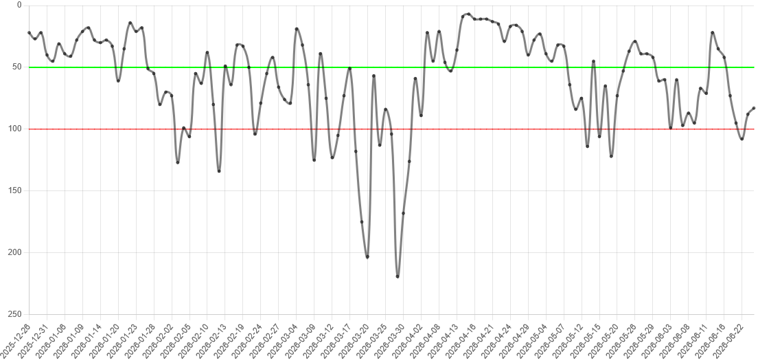
Six-month chart of NYSE New Lows with price levels at 50 and 100 (Source: ShadowridgeData.com)
Our Shadowridge Long-Term Trend indicator has remained positive since April 8th, suggesting the market could continue moving higher. Even with the market drifting lower in June, this indicator did not indicate a need to get defensive.
Our Mid-Term Cycle indicator is as neutral as it can be. Not showing strength or weakness worth following. If seasonal trends continue to play out, then this is one of the first places we’ll see a heads-up signal. So we’ll be watching.
As of Wednesday night (June 24th, 2026), our Shadowridge Dashboard showed Positive to Negative market sectors as 5 to 6. Financials are now the stand-out positive sector, while Energy and Communication are the relative laggards.
Right now, 9 RGB Bond Indexes are back to trending positive, all above their 50-day Moving Averages. Interesting to note that the one weak bond sector shifted this month from US Treasuries (last month) to Inflation Protection Bonds (this month). That feels a bit Fed-driven for now and is something to keep in mind going into the summer.
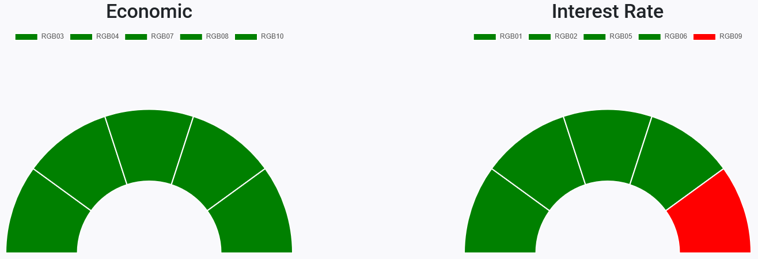
RGB Economic and Interest Rate Sensitive Bond sectors (Source: ShadowridgeData.com)
Traditional Bond sectors continue to offer limited diversification benefits during periods of volatility. The 7-10 year Treasuries (IEF) and the Aggregate Bond Index (AGG) are both flat or just under 1% on the year. We still find limited benefit in these traditional asset classes. This remains one of the easiest portfolio fixes we see when reviewing how people are generally allocated. It may be a little bit outside the box, but we’ve found this approach may be helpful in certain market environments (like now).
Bottom Line: After a strong April and May, we had a very “meh” June. But historical seasonal patterns suggest we could be setting up for a strong July. The broad bond market is (again) offering no benefit to diversification, so we continue to be selective within fixed income rather than relying primarily on traditional core bond sectors. There hasn’t been enough of a reason to get defensive, so we haven’t made many changes in the past month. For now, we remain optimistic on the rest of 2026 until the data proves to us otherwise.
Stay safe out there!
Important Disclosure Information
Please remember that past performance is no guarantee of future results. Different types of investments involve varying degrees of risk, and there can be no assurance that the future performance of any specific investment, investment strategy, or product (including the investments and/or investment strategies recommended or undertaken by Shadowridge Asset Management, LLC [“Shadowridge]), or any non-investment related content, made reference to directly or indirectly in this commentary will be profitable, equal any corresponding indicated historical performance level(s), be suitable for your portfolio or individual situation, or prove successful. Due to various factors, including changing market conditions and/or applicable laws, the content may no longer be reflective of current opinions or positions. Moreover, no portion of the foregoing content serves as the receipt of, or a substitute for, personalized investment advice from Shadowridge. Neither Shadowridge’s investment adviser registration status, nor any amount of prior experience or success, should be construed that a certain level of results or satisfaction will be achieved if Shadowridge is engaged, or continues to be engaged, to provide investment advisory services. Shadowridge is neither a law firm, nor a certified public accounting firm, and no portion of the commentary content should be construed as legal or accounting advice. A copy of the Shadowridge’s current written disclosure Brochure and Form CRS discussing our advisory services and fees continues to remain available upon request or at www.shadowridgeinvest.com. Please Remember: If you are a Shadowridge client, please contact Shadowridge, in writing, if there are any changes in your personal/financial situation or investment objectives for the purpose of reviewing/evaluating/revising our previous recommendations and/or services, or if you would like to impose, add, or to modify any reasonable restrictions to our investment advisory services. Unless, and until, you notify us, in writing, to the contrary, we shall continue to provide services as we do currently. Please Also Remember to advise us if you have not been receiving account statements (at least quarterly) from the account custodian.
Historical performance results for investment indices, benchmarks, and/or categories have been provided for general informational/comparison purposes only, and generally do not reflect the deduction of transaction and/or custodial charges, the deduction of an investment management fee, nor the impact of taxes, the incurrence of which would have the effect of decreasing historical performance results. It should not be assumed that your Shadowridge account holdings correspond directly to any comparative indices or categories. Please Also Note: (1) comparative benchmarks/indices may be more or less volatile than your Shadowridge accounts; and, (2) a description of each comparative benchmark/index is available upon request or at www.shadowridgeinvest.com.